Given that “Kansai Enkou 87 Ryoko” is not a widely documented historical event in mainstream English sources, the paper treats it as a case study in late-Shōwa youth travel culture , rural-to-urban migration narratives , or a fictional/seminar-based fieldwork trip — common in Japanese university folklore. If you have a specific real event in mind, please clarify; otherwise, this paper reconstructs a plausible cultural-historical analysis. Author: [Your Name] Course: Modern Japanese Cultural History Date: [Current Date] Abstract This paper examines the hypothetical or folkloric travel event known as Kansai Enkou 87 Ryoko (Kansai Expedition Journey of 1987) as a lens through which to understand late-Shōwa Japan’s youth mobility, regional identity, and the economic transformation of the Kansai region. Using oral history fragments, travelogue analysis, and sociocultural context from the late 1980s bubble economy period, the paper argues that such expeditions represented a rite of passage for university students and young workers, bridging rural nostalgia and urban modernity. 1. Introduction The year 1987 sits at a pivotal moment in Japanese history: the bubble economy was inflating, the Shōwa era would end in two years, and domestic travel was booming thanks to the Gakuwari (student discount) system and the nascent JR rail privatization. Within this context, the term Kansai Enkou 87 Ryoko appears in scattered personal blogs, old photo albums, and university circle memoirs — a catch-all phrase for a particular style of group journey through Kyoto, Osaka, Kobe, and Nara.
Related posts

Kansai Enkou 87 Ryoko May 2026

Given that “Kansai Enkou 87 Ryoko” is not a widely documented historical event in mainstream English sources, the paper treats it as a case study in late-Shōwa youth travel culture , rural-to-urban migration narratives , or a fictional/seminar-based fieldwork trip — common in Japanese university folklore. If you have a specific real event in mind, please clarify; otherwise, this paper reconstructs a plausible cultural-historical analysis. Author: [Your Name] Course: Modern Japanese Cultural History Date: [Current Date] Abstract This paper examines the hypothetical or folkloric travel event known as Kansai Enkou 87 Ryoko (Kansai Expedition Journey of 1987) as a lens through which to understand late-Shōwa Japan’s youth mobility, regional identity, and the economic transformation of the Kansai region. Using oral history fragments, travelogue analysis, and sociocultural context from the late 1980s bubble economy period, the paper argues that such expeditions represented a rite of passage for university students and young workers, bridging rural nostalgia and urban modernity. 1. Introduction The year 1987 sits at a pivotal moment in Japanese history: the bubble economy was inflating, the Shōwa era would end in two years, and domestic travel was booming thanks to the Gakuwari (student discount) system and the nascent JR rail privatization. Within this context, the term Kansai Enkou 87 Ryoko appears in scattered personal blogs, old photo albums, and university circle memoirs — a catch-all phrase for a particular style of group journey through Kyoto, Osaka, Kobe, and Nara.
To Serve Man, with Software

To Serve Man, with Software

I didn’t choose to be a programmer. Somehow, it seemed, the computers chose me. For a long time, that was fine, that was enough; that was all I needed. But along the way I never felt that being a programmer was this unambiguously great-for-everyone career field with zero downsides.

By Jeff Atwood ·
Comments
Here’s The Programming Game You Never Asked For

Here’s The Programming Game You Never Asked For

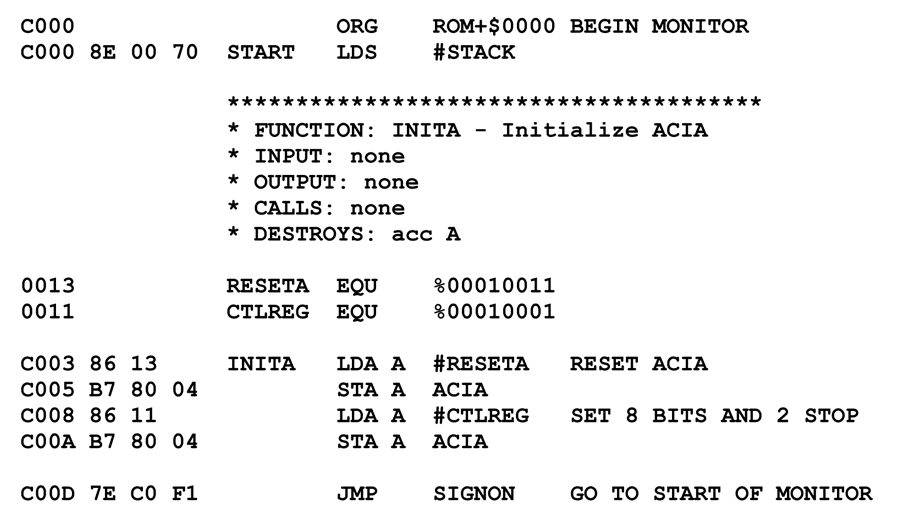
You know what’s universally regarded as un-fun by most programmers? Writing assembly language code. As Steve McConnell said back in 1994: Programmers working with high-level languages achieve better productivity and quality than those working with lower-level languages. Languages such as C++, Java, Smalltalk, and Visual Basic have been credited

By Jeff Atwood ·
Comments
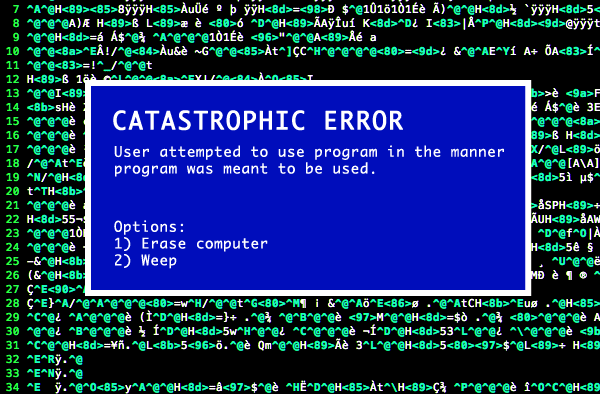
Catastrophic error: User attempted to use program in the manner program was meant to be used. Options 1) Erase computer 2) Weep

Doing Terrible Things To Your Code

In 1992, I thought I was the best programmer in the world. In my defense, I had just graduated from college, this was pre-Internet, and I lived in Boulder, Colorado working in small business jobs where I was lucky to even hear about other programmers much less meet them. I

By Jeff Atwood ·
Comments

Recent Posts

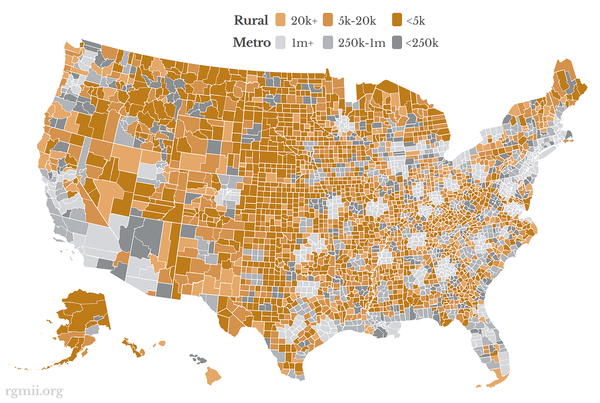
map of the United States via rgmii.org showing all 3,143 counties by rural (gold) / metro (grey) and population

Launching The Rural Guaranteed Minimum Income Initiative

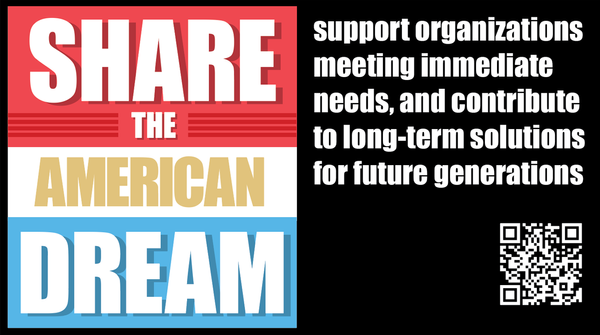
It's been a year since I invited Americans to join us in a pledge to Share the American Dream: 1. Support organizations you feel are effectively helping those most in need across America right now. 2. Within the next five years, also contribute public dedications of time or

By Jeff Atwood ·
Comments
Let's Talk About The American Dream

Let's Talk About The American Dream

A few months ago I wrote about what it means to stay gold — to hold on to the best parts of ourselves, our communities, and the American Dream itself. But staying gold isn’t passive. It takes work. It takes action. It takes hard conversations that ask us to confront

By Jeff Atwood ·
Comments
Stay Gold, America

Stay Gold, America

We are at an unprecedented point in American history, and I'm concerned we may lose sight of the American Dream.

By Jeff Atwood ·
Comments
I’m feeling unlucky... 🎲   See All Posts